Orolight® :
The future of
precision light therapy
Physical foundations
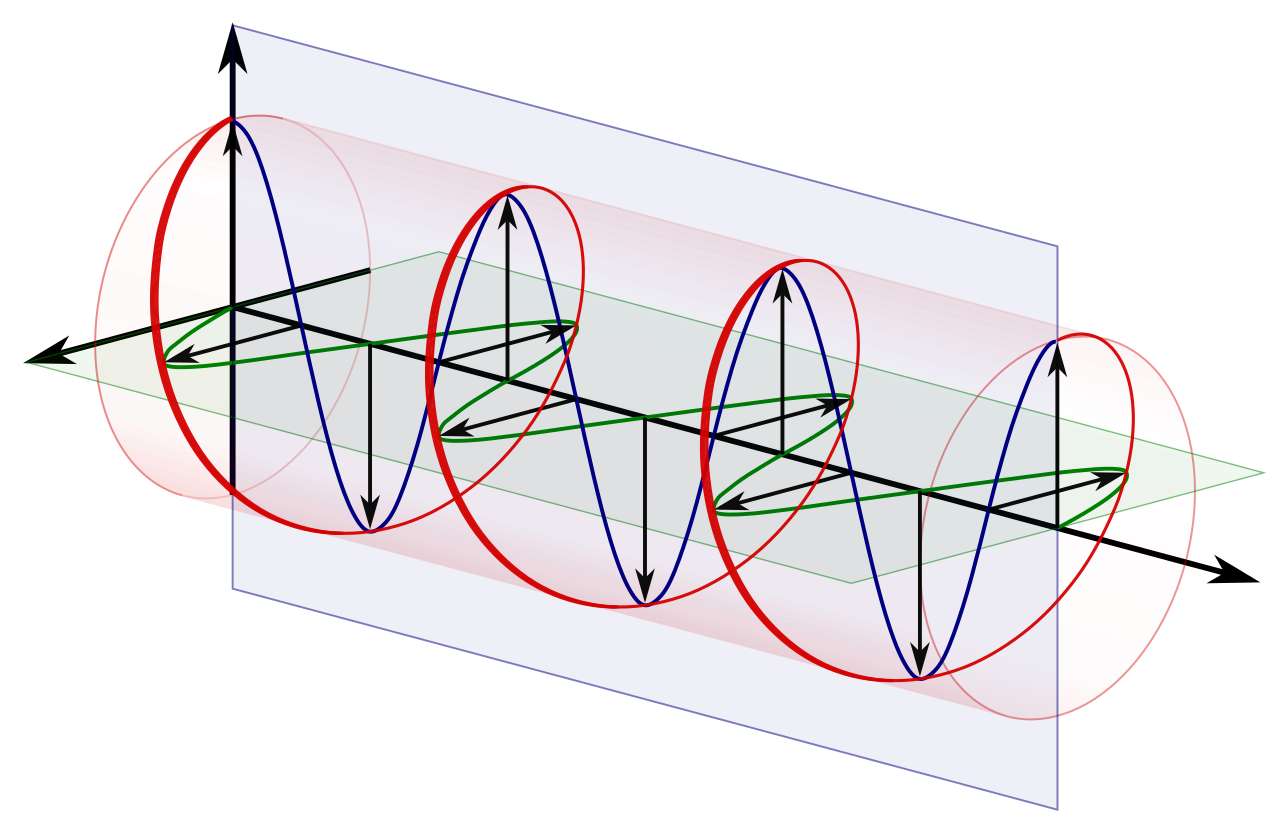
Circularly Polarized Light (CPL) fundamentally differs from conventional light sources through one key physical property: it carries a coherent, net and oriented Spin Angular Momentum (SAM).
A net, oriented SAM adds an extra
dimension to the signal : its geometry.
When the field geometry changes, the interaction with matter changes.
All photons have a spin of +1 or −1. Spin sets the polarization: it determines whether the electric field oscillates (linear polarization) or rotates (circular polarization).
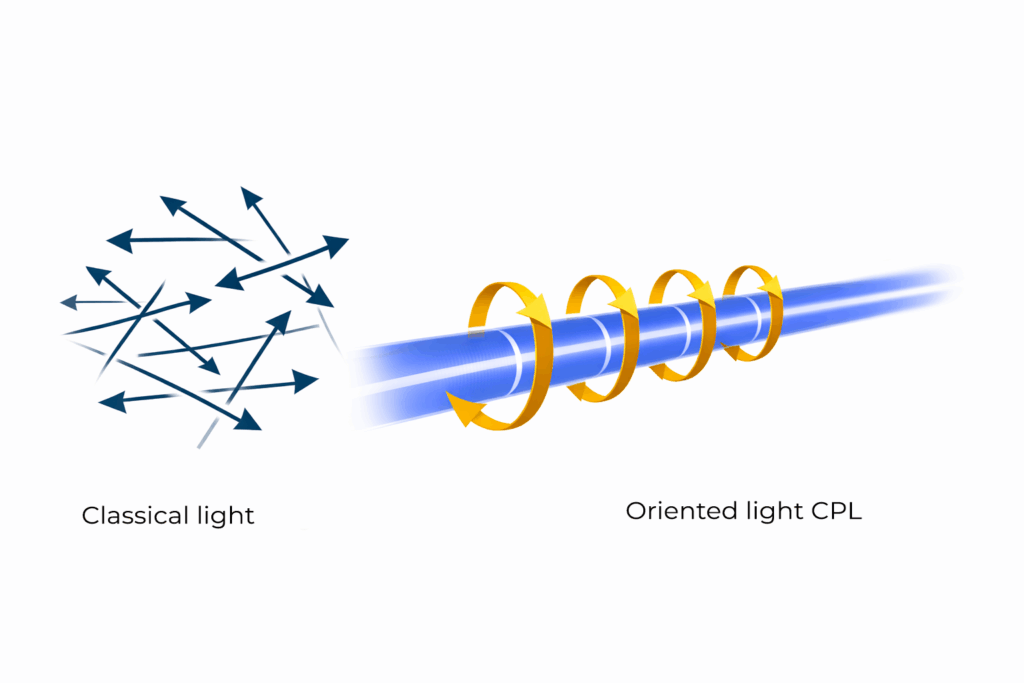
In conventional light sources, opposite spins coexist and cancel out:
Spin +1 and −1 are mixed — no selection.
The global spin angular momentum (SAM) is zero → the electric field oscillates in a fixed plane or changes direction randomly.
No stable chirality is defined.
The interaction therefore relies mainly on local energy absorption (chromophores, dose, wavelength). The field has no intrinsic rotational orientation, so it does not introduce a chiral variable (right/left) capable of structuring the light–matter interaction in a reproducible way.
By contrast, circularly polarized light (CPL) selects a single spin state:
100% spin +1 → right-handed CPL (R)
100% spin −1 → left-handed CPL (L)
The signal is clean and oriented:
Only one spin state is present (spin +1 or spin −1).
SAM is non-zero → the electric field undergoes continuous rotation.
Stable, defined optical chirality (right or left).
By selecting a single spin state, CPL does not only deliver energy: it imposes an oriented field geometry—i.e., a direction. The beam carries a stable rotation of the electric field—right (R) or left (L)—adding an interaction variable that is absent in conventional light sources: optical chirality.

What are the physical and biological consequences?
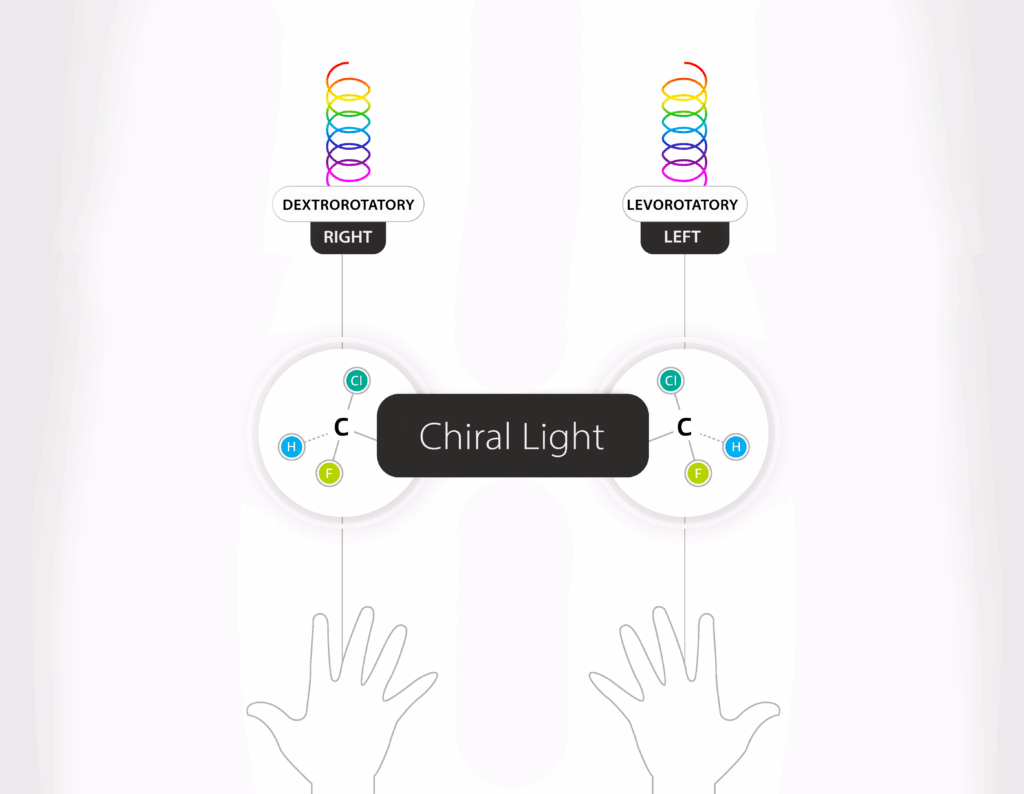
A more selective interaction with matter.
The light signal becomes compatible with the chirality of living systems.
Biological systems are largely structured by chirality:
Amino acids : predominantly L forms (levorotatory),
Proteins : built from L “bricks”, with variable 3D geometry,
DNA: mostly right-handed helices,
Fibrillar structures and extracellular matrices: hierarchical and organizational chirality.
An electromagnetic wave that is itself chiral interact selectively and differentially with these asymmetric architectures.
By providing an electromagnetic field with controlled chirality (R/L), CPL modulate the interaction with biological matter and influence the response without increasing dose, but through interaction geometry.
This opens a more subtle route to regulation: at comparable energy, CPL produce more organized effects (coherence, tissue-level structuring, more reproducible responses), because the R/L information acts as a selection parameter in light–matter coupling.
A deeper diffusion and propagation
Spin–orbit coupling and propagation geometry.
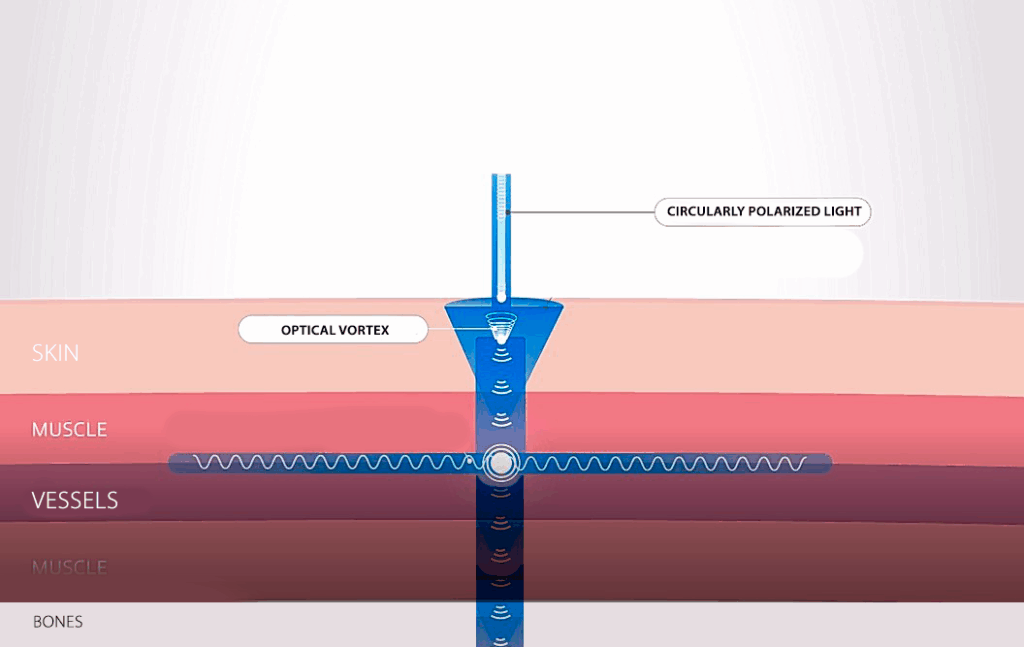
When CPL enters an anisotropic, chiral, and inhomogeneous medium such as biological tissue part of its spin angular momentum can be converted into Orbital Angular Momentum (OAM).
This phenomenon, known as the Spin–Orbit Coupling of Light, results in a local modification of the wavefront geometry: the beam locally adopts a helical structure, forming an optical vortex.
SAM → OAM conversion is only possible if light carries an initial net spin:
CPL → net, coherent SAM → efficient conversion
Elliptical light → partial SAM → weak conversion
Linear or unpolarized light → zero SAM → no conversion
This SAM → OAM conversion does not create more energy : it changes the wavefront geometry and the way the signal propagates. When a vortex forms, the beam acquires a helical phase and a more stable propagation axis, making it less sensitive to polarization breaks and to local anisotropy variations.
In heterogeneous biological tissue, this favors more robust propagation : what diffuses is not only energy, but coherent optical information (R/L orientation, phase structure), able to remain organized despite micro-fibrillar structures. The interaction can thus become more homogeneous and deeper, without thermal or mechanical effects.
This is what differentiates CPL from a “surface phototherapy”: the wavelength retains its interaction potential (its “message”) in a structured form, and can be transported further into tissue than light that rapidly loses structure (unpolarized, linear, or elliptical light).
This structured propagation may also extend along continuous connective networks often associated with acupuncture meridian pathways facilitating functional diffusion at a distance.
This supports propagation coherence and enables a more regular and reproducible effect.
Low-intensity physiological regulation
CPL is not a light designed to “force” living systems to produce an outcome. It improves signal coherence (R/L orientation) and propagation robustness (structured modes / vortex-like dynamics), enabling broader and more consistent therapeutic action at low intensity.
Living tissue is not passive matter: it regulates continuously. When stimulation is too strong (heating, irritation, local overload), responses tend to become defensive: stress vasomotor reactions, superficial effects, point-to-point variability, and sometimes saturation. By contrast, when remaining below thermal thresholds, the response is more often an adjustment: the system uses the signal as information, not as a constraint.